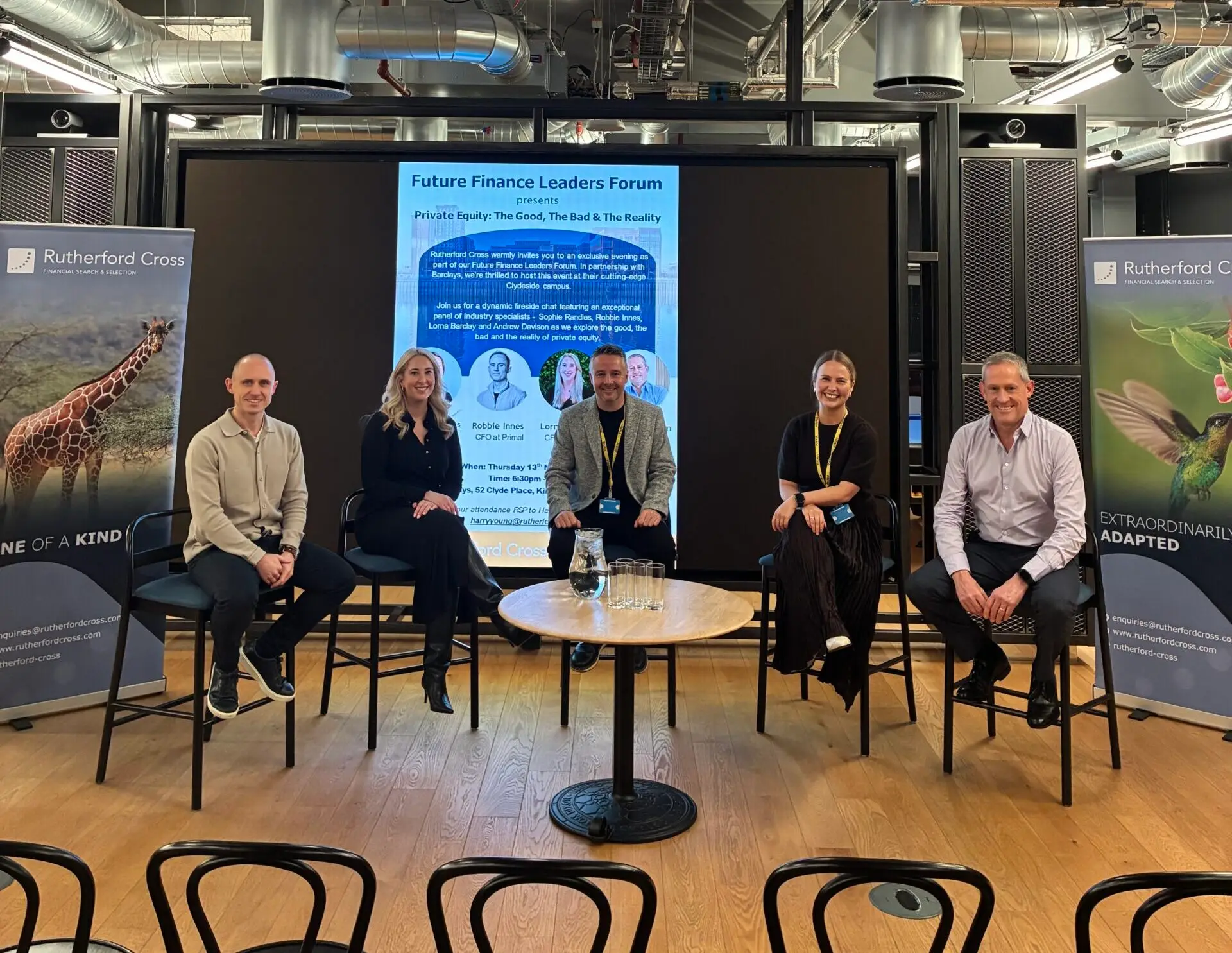
On Thursday 13th November, Rutherford Cross was delighted to host the latest instalment of our Future Finance Leaders Forum. This session explored The Good, The Bad and The Reality of private equity with an expert panel drawn from across the industry.
The event took place at the impressive Barclays Campus in Glasgow, where their team looked after us brilliantly. Jonathan Donnelly of Rutherford Cross compered the evening and was joined by:
- Andrew Davison, Partner, Scottish Equity Partners
- Robbie Innes, CFO, Primal (backed by Flywheel Partners)
- Lorna Barclay, CFO, Pelion (backed by Scottish Equity Partners)
- Sophie Randles, Director and PE-focused Headhunter, Livingston James
A Closer Look at the Scottish PE Market
The discussion began with an overview of the Scottish private equity landscape from Andrew Davison. He reviewed KPMG’s 2024 report, which highlighted a total investment value of £9.4 billion, a 35.6% increase on 2023, with deal volumes rising from 92 to 111.
However, Andrew challenged the conclusions, demonstrating that the headline figures present a more optimistic picture than reality. A small number of major transactions were responsible for the bulk of the investment value, including Nationwide’s acquisition of Virgin Money, the sale of Edinburgh Airport, the acquisition of Cala Homes, the acquisition of KCA Deutag and share buybacks by NatWest and Vinci Airports.
Experiences from PE-Backed Businesses
Robbie Innes shared insights from his experience working in two PE-backed businesses, as well as his earlier career in Deloitte’s transaction services team. He cautioned against generalising life in a PE-backed environment, noting that expectations vary widely between firms depending on portfolio makeup, exit strategies and risk appetite. Consequently, the pressures and priorities can differ significantly from one investment to another.
Robbie and Lorna then reflected on how the CFO role in a PE-backed business often stretches far beyond financial oversight. Success requires deep engagement with operational drivers and commercial objectives. Lorna emphasised the importance of effective delegation, building trust within the finance team and ensuring confidence in the management of day-to-day financial responsibilities.
Skillsets for CFOs in the PE Market
Sophie Randles offered her perspective on what defines the next generation of CFOs in private equity-backed businesses. Above all, adaptability is essential. Modern CFOs must operate across the full spectrum, from strategic leadership to hands-on detail, switching seamlessly between shaping long-term growth plans and maintaining daily financial rigour.
Understanding the investor mindset is equally critical: speaking the language of value creation, anticipating key questions and maintaining transparency to build trust. Sophie also highlighted the importance of reading the dynamics of the boardroom, understanding the different priorities of investors, founders and independent directors and learning how to influence without relying on formal authority.
Lorna built on this by emphasising the need for finance leaders to engage deeply with operations and sales, demonstrating how finance drives commercial success and helping the wider business appreciate its strategic influence. In a market where deals take longer and uncertainty is persistent, resilience becomes non-negotiable. Both Lorna and Robbie shared how stepping out of their comfort zones to understand their markets has been vital to their success.
Sophie’s advice to aspiring CFOs was clear: commit to continuous learning, particularly in areas such as technology, data analytics and ESG capabilities that are increasingly central to success in PE-backed environments.
Globalisation, Opportunity and the Realities of PE
The evening concluded with thought-provoking questions from the audience. Andrew reflected on how the globalisation of markets is reshaping private equity, noting that SEP’s focus is increasingly on backing the right scale-up technology businesses, regardless of location. This shift is likely to create new opportunities for Scottish companies to attract investment from international PE houses.
The panel agreed that working in private equity is exciting, fast-paced and often high-pressure compared with other ownership models. It is not for everyone; it demands sacrifice, resilience and strong stakeholder management, along with an acceptance that there will be bumps in the road. For those who thrive in such an environment, however, the opportunities for growth and impact are significant.
The session was exceptionally well received by those who attended and we were thrilled to welcome over 50 guests on a typically cold, wet November evening in Glasgow. We are very grateful to our panel for giving up their time and for sharing such valuable and candid insights.
If you are interested in attending the next instalment of the Future Finance Leaders Forum, please do not hesitate to reach out to Jonathan Donnelly: [email protected]