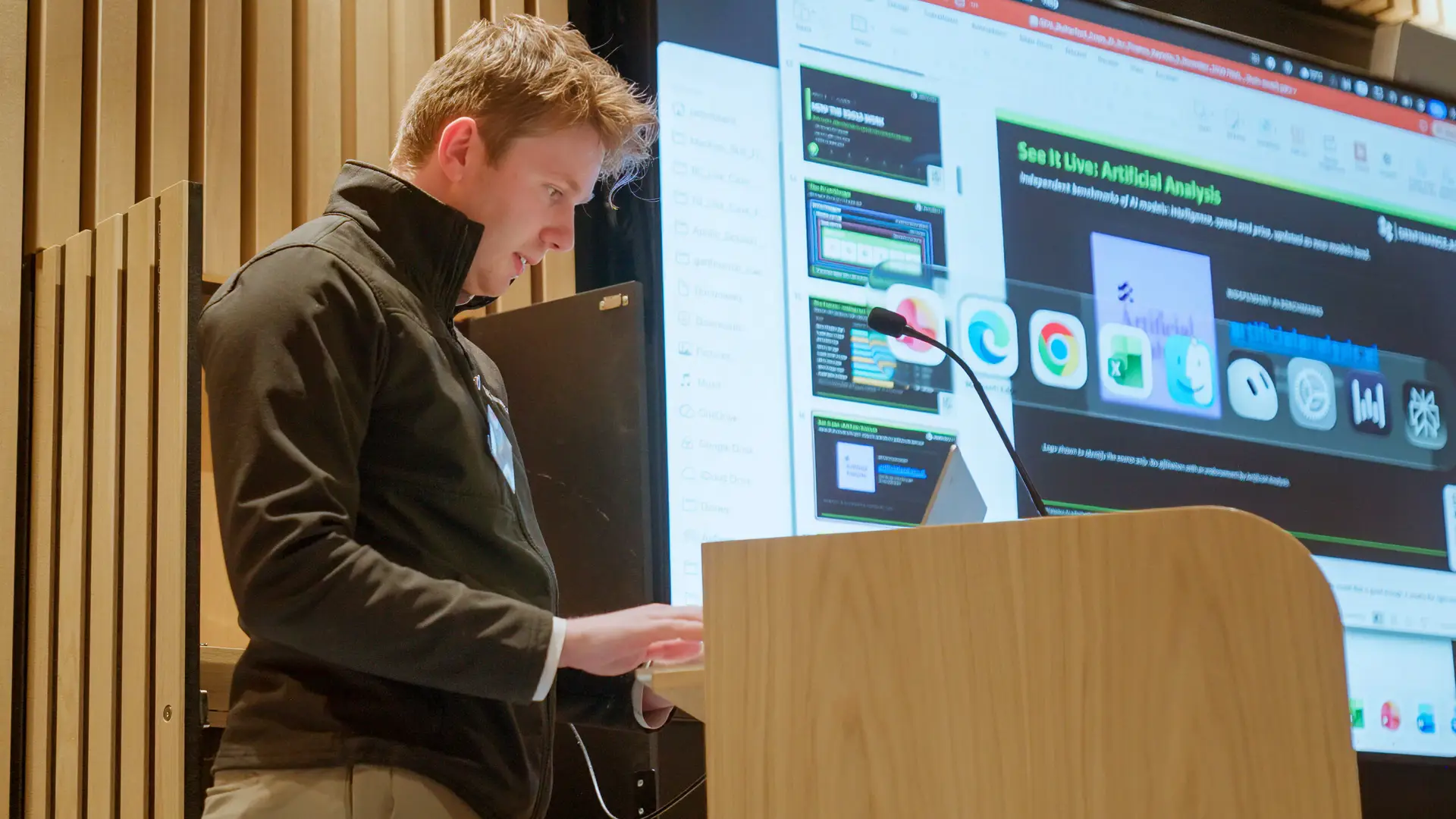
Rutherford Cross Consultant Kamran Chaudhry shares key insights from the Rutherford Cross Interim & Fractional CFO Conference, including discussions on how finance leaders can embrace AI while maintaining strong governance, oversight and professional judgement.
Peter Beard on AI in Finance
One of the standout sessions at the Rutherford Cross Interim & Fractional CFO Conference came from Peter Beard ACA, founder of GenFinance.AI, who delivered an interactive and highly practical session on the growing role of artificial intelligence within finance teams. Peter combines a background in audit at EY with his current work helping businesses implement AI solutions, making him uniquely positioned to bridge the gap between finance expertise and emerging technology.
Peter first focused on understanding where attendees were on their AI journey. The room, made up largely of senior finance leaders, interim CFOs and fractional finance professionals, revealed a familiar picture. Around half of participants described themselves as still experimenting with AI, while only 4% said they had reached the stage of scaling its use across their organisations. This reinforced the reality that while interest in AI is widespread, adoption remains in its early stages.
Peter also asked attendees what excites them most about AI. The responses centred around speed, efficiency and the opportunity to commercialise insights more effectively. These benefits resonate with finance professionals who continue to face increasing demands for faster reporting, deeper analysis and more strategic contributions to decision-making. The biggest worries raised by the audience were inaccuracies, security and the risk of data loss. These concerns featured heavily throughout the session and aligned with one of Peter’s key messages: AI can significantly improve productivity, but it must be deployed with appropriate controls, governance and human oversight. As finance professionals, accountability remains with us, not the technology.
One of the most thought-provoking ideas from the presentation was the changing role of finance professionals in an AI-enabled world. Peter argued that AI is increasingly becoming the producer of information, while humans should remain the reviewers, interpreters and decision-makers. He illustrated how activities traditionally consuming large amounts of time, such as reconciliations, report preparation and commentary writing, can be accelerated by AI, allowing finance leaders to spend more time exercising judgement and providing commercial advice.
A Practical Framework for Using AI Effectively
A particularly useful framework shared during the session was FACETS, developed with the ICAEW, a structured approach to prompting AI effectively. FACETS stands for Task, Audience, Context, Example, Format and Sources. Rather than giving vague instructions such as “write me a cash flow forecast”, Peter demonstrated how providing clear context, intended audience and source data dramatically improves the quality and reliability of AI outputs. For many attendees, this was a practical takeaway that could be applied immediately within their own organisations.
The highlight of the session was a live demonstration showing Microsoft Copilot, Claude and ChatGPT working side-by-side on real-world finance tasks. One example involved generating a 13-week cash flow forecast using the FACETS methodology. Rather than simply producing numbers, the exercise showed how AI can create a structured, reviewable output, complete with assumptions, validation checks and stress-testing scenarios. The emphasis was not on replacing finance professionals, but on producing a better first draft that could then be reviewed and challenged by an experienced finance leader.
From Experimentation to Scale
Peter closed with a message that resonated strongly across the room: AI adoption is not about transforming everything overnight. The most successful organisations will start with one task, establish robust review processes and gradually build confidence from there. For many of the finance leaders in attendance, the question is no longer whether AI will become part of the finance function, but how to move from experimentation to scaling in a controlled and commercially valuable way.
The session provided a valuable reminder that whilst AI may be changing how finance work is performed, the importance of professional judgement, governance and trusted human oversight has never been greater.
Interested in how AI is transforming the finance function? Get in touch with the Rutherford Cross team to discuss the evolving finance leadership landscape and upcoming Interim & Fractional CFO events: