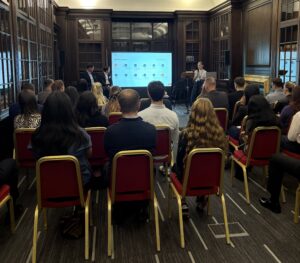
Rutherford Cross Tax Specialist, Ben Jones, recently hosted a Roundtable event with senior tax professionals to explore the issues shaping the future of the profession. Discussions ranged from the impact of AI and talent development to tax administration, policy and economic growth.
Talent, Technology and the Need for Simplicity
Recently, I had the rare opportunity to host a roundtable with senior tax professionals from both practice and industry at our St Vincent Street office in Glasgow, very kindly chaired by John McAuslin, Partner and Head of Corporate Tax at Johnston Carmichael. Over the course of the morning we tackled two key areas:
- Developing and retaining tax talent in the era of technology, automation, and AI
- The Future of Tax Policy and Administration, what changes you anticipate and would like to see.
Preserving Technical Expertise in an AI-Driven World
There was broad agreement that technology and AI will continue to transform the profession, but few believed they would replace the need for deep technical expertise. A recurring observation was that experienced tax professionals can often identify when AI-generated answers are incorrect because they possess the technical grounding to challenge the output. The concern is whether future generations will develop those same instincts. If professionals increasingly rely on technology from the outset of their careers, will they build the depth of understanding required to recognise when something is wrong?
Several attendees reflected on how tax professionals learned in previous generations. There was a time when trainees were actively discouraged from relying on tools such as Google, instead developing their knowledge through technical study, legislation and reference materials. The discussion around VAT revision books brought a degree of nostalgia, but it also highlighted a serious point: the profession must ensure core tax knowledge remains protected, regardless of how powerful technology becomes.
Rethinking How Tax Talent Is Developed
Many attendees noted that the traditional career model is evolving. Firms are increasingly operating with flatter structures, and there is evidence that fewer graduates are entering some parts of the profession. This raises important questions about the future pipeline of talent.
The tax profession has historically relied on an apprenticeship-style model, where junior staff learn from those around them. Almost everyone in the room could point to an experienced colleague who had shaped their development. One particularly memorable comment was that a senior individual had “seen something in me that I didn’t see in myself”. That ability to coach, mentor and inspire remains a critical component of professional development.
At the same time, the profession faces a paradox. Younger professionals increasingly value flexible and remote working, yet many of the strongest learning experiences come from being physically present alongside experienced colleagues. The challenge for employers is finding ways to maintain the benefits of mentorship and collaboration while accommodating modern expectations around flexibility.
The Rise of Tax Technology Skills
While technical expertise remains essential, the future tax professional will almost certainly require a broader skill set. Tax technology was repeatedly highlighted as an area of growing importance, with many expecting dedicated tax technology roles to become increasingly common.
However, there was also frustration with the current state of some tax software. Several attendees felt existing systems remain behind the curve, particularly when compared with the pace of technological advancement elsewhere in the economy. This creates both a challenge and an opportunity. Firms need professionals who understand tax, but who can also evaluate technology, improve processes and help drive digital transformation.
The growing significance of areas such as ESG reporting, international compliance and initiatives such as Carbon Border Adjustment Mechanism (CBAM) reinforces the fact that future tax professionals are likely to work across a broader range of disciplines than ever before.
Concerns Around HMRC and Tax Administration
A significant portion of the discussion focused on HMRC and the practical administration of the tax system.
Many attendees expressed concern that HMRC is struggling to train and retain people quickly enough to meet growing demands. There was a perception that technical expertise can be difficult to maintain when experienced individuals are promoted into different areas, leaving gaps in specialist knowledge.
Participants also discussed the challenges that arise during enquiries and technical discussions. A common frustration was that taxpayers are often unable to see the full internal process once a technical issue is escalated within HMRC. This can create uncertainty around whether the nuances of a particular situation are fully understood.
Alongside this, discussions touched on initiatives such as Project Snowball, which reflects HMRC’s increasing focus on systems, controls and governance rather than simply reviewing individual tax returns.
Tax Policy, Complexity and the Need for Growth
The conversation also moved beyond administration and into tax policy. Several contributors felt that tax has become increasingly complex and questioned whether sufficient emphasis is being placed on simplification.
The potential return of the Office of Tax Simplification was raised as something many would welcome. There was also discussion around VAT and the perception that tax policy can sometimes be used as a political tool rather than purely as an economic one.
Closer to home, concerns were raised about the Scottish mid-market and whether enough incentives exist to encourage growth. Some participants suggested that entrepreneurs and founders may increasingly look overseas when making investment and expansion decisions. Combined with the growing demands of international developments such as Pillar Two, there was a feeling that policymakers need to strike a better balance between compliance, competitiveness and economic growth.
The Value of Bringing People Together
If there was one overarching theme from the discussion, it was that people remain at the heart of the profession.
Technology will continue to evolve. AI will become more capable. Tax administration will become increasingly digital. Yet the profession still depends on experienced individuals passing knowledge to the next generation, challenging assumptions and applying judgement where technology falls short.
That is also why roundtables remain so valuable. Bringing together professionals with different perspectives allows ideas to be tested, concerns to be shared and solutions to emerge. The most striking conclusion from the discussion was that the future challenge is not whether technology can answer tax questions; it is whether the profession can continue developing people with enough expertise, judgement and curiosity to know when those answers should be challenged.
If you would like to be a part of future tax roundtables and events, please contact Ben Jones: [email protected]