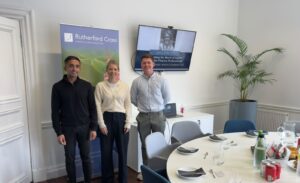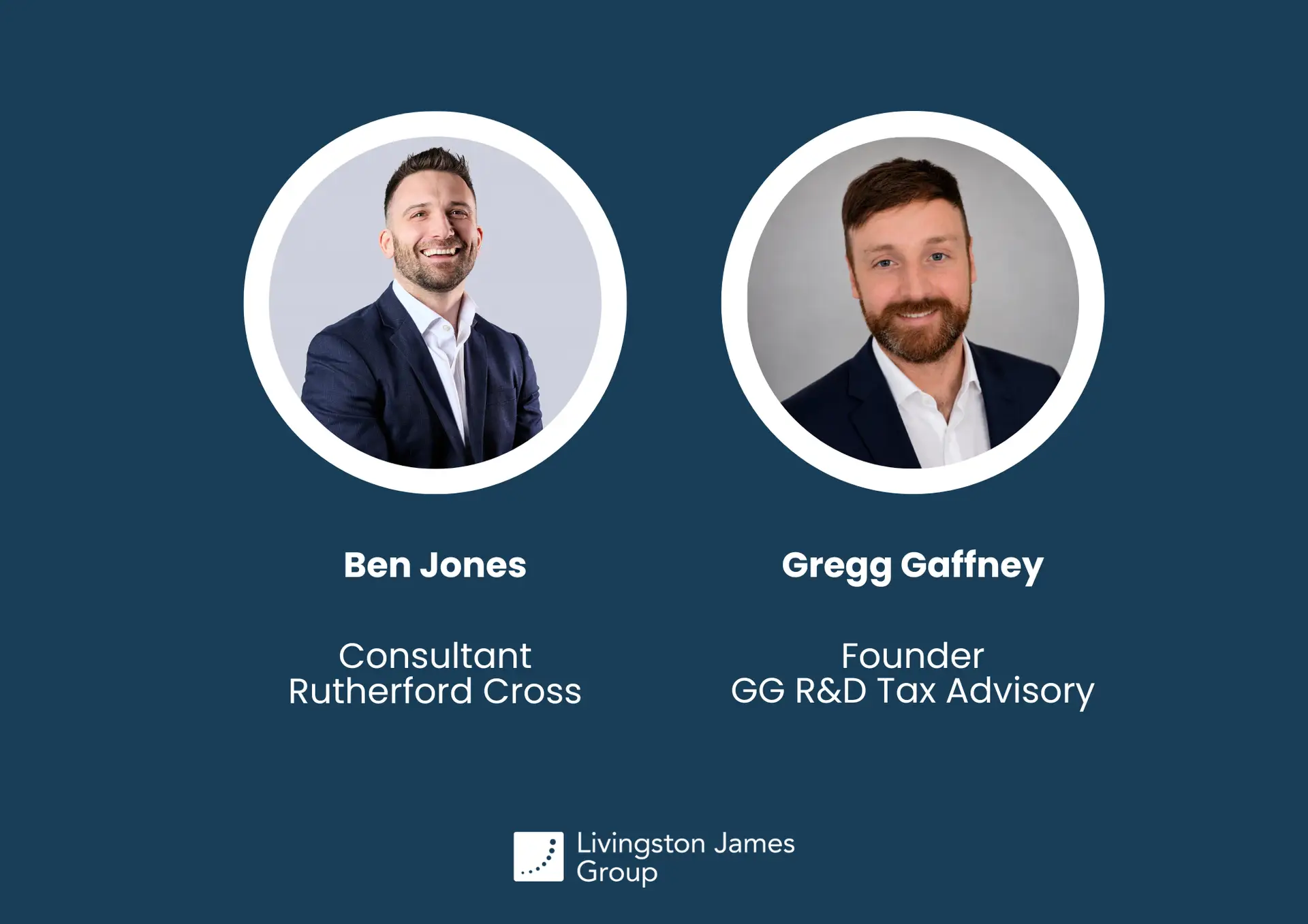
Rutherford Cross Tax Specialist, Ben Jones, recently spoke with Gregg Gaffney, founder of GG R&D Tax Advisory, about his journey from engineering and infrastructure projects to launching his own specialist consultancy. Reflecting on innovation, entrepreneurship and the Scottish technology ecosystem, Gregg shared the experiences that shaped both his career and his approach to building a business.
Founders are everywhere. From appearing on podcasts like Diary of a CEO to walking out the elevator on Dragon’s Den. You will likely know someone in your network who took the plunge and went it alone to start their own business.
Personally, I think it’s one of the bravest things you can do (far too scary for me), and I come across many independent tax accountancy firms and one-person bands. I was keen to learn more about what it takes to take that leap of faith, and recently sat down with Gregg Gaffney, founder of GG R&D Tax Advisory.
One of the must-haves for founders if they want to be quickly successful is that they must be likeable, and Gregg definitely ticks that box. A scouser who has infiltrated Scotland and now calls Edinburgh his home, he comes across as authentic, humble and has a deep passion for his craft.
We could have spent the hour discussing Gianni Infantino’s impending downfall at FIFA and Liverpool’s summer transfer window, but eventually we turned to his roots, early career and what had led him to his business today.
Whether he was talking about studying engineering, working on London’s Underground network, advising businesses on R&D tax relief, or building his own consultancy from scratch, the common themes of innovation and curiosity tied everything together.
“I guess there’s always been that design, innovation and problem-solving spin on things that I’ve been interested in.”
From Engineering to Problem Solving
That interest first took Gregg to the University of Bath, where he studied Mechanical Engineering before specialising in Advanced Design and Innovation. Whilst many engineering degrees culminate in a traditional dissertation, his specialism centred around developing practical solutions and creating products.
The course wasn’t simply about understanding how things worked. It was about figuring out how to make them work better and it is a mindset that has followed him throughout his career.
After graduating, Gregg joined a large engineering consultancy in London, working on major infrastructure projects alongside London Underground. It was the sort of role many engineers dream about. Large-scale projects, cutting-edge systems and the opportunity to contribute to infrastructure used by millions of people every year.
“We’d be down in the tunnels looking at infrastructure that was over 150 years old, trying to work out where we could squeeze new equipment in without it being hit by a train.”
It is easy in this age of social media to associate innovation with self-driving cars, self-landing rockets and robots that can unpack your dishwasher, but in reality, a huge amount of innovation is simply solving difficult problems within challenging constraints.
Discovering the Commercial Side of Innovation
After several years in engineering, Gregg found himself increasingly interested in the commercial impact of innovation.
The technical work remained fascinating, but he was becoming curious about what happened further upstream: how businesses funded development, scaled and achieved commercial success. That curiosity ultimately led him into the R&D tax market.
“It was still technology. It was still innovation. It was still learning about product development. But there was a much more tangible commercial impact.”
What attracted him wasn’t just the legislation itself, but the opportunity to engage with innovative businesses and the people building them.
Learning from Industry Leaders
Over the next several years, Gregg worked across a number of advisory firms, supporting companies within industries including engineering, manufacturing, electronics, life sciences, energy and software. Some projects involved advanced manufacturing processes. Others focused on satellite technologies, quantum systems and even nuclear fusion research.
“There were definitely conversations where you were speaking to leading experts and thinking, “I really hope I don’t ask a stupid question here!”
What he learned, however, was that even the most advanced technologies often boil down to surprisingly simple challenges.
“You can break a lot of engineering down into something quite straightforward. Maybe something wouldn’t fit, maybe it would overheat, maybe it couldn’t operate in that environment. The underlying problem is usually more relatable than people think.”
Launching GG R&D Tax Advisory
Earlier this year, Gregg launched GG R&D Tax Advisory, a specialist consultancy focused on supporting innovative businesses, particularly within engineering-led sectors. It gradually emerged through years of observing different businesses, working with different clients and understanding where his own strengths sat. Over time, he recognised a gap for a consultancy that combined technical understanding with specialist R&D expertise.
“I think a niche gradually presented itself. There’s an opportunity to support engineering-focused businesses with somebody who genuinely understands the technology.”
During our conversation, Gregg spoke openly about one of the practical realities of R&D tax work. Whilst finance teams often understand the benefit of an R&D claim immediately, engineering teams don’t always share the same enthusiasm.
After all, they are typically focused on developing products, solving technical problems and delivering projects. R&D tax can sometimes feel like a distraction.
“If I can build a relationship based on genuine enthusiasm for their technology, then preparing the R&D claim becomes a natural continuation of that conversation.”
It is a subtle distinction, but an important one. Gregg doesn’t see himself as someone simply preparing claims. He sees himself as someone helping innovative businesses continue to do so.
Scotland’s Thriving Innovation Ecosystem
One of the most enjoyable parts of our discussion was hearing how immersed he has become in Scotland’s innovation ecosystem since launching his business. It has given him a front-row seat to the volume of innovation happening across Scotland.
“I don’t think I fully appreciated how much high-tech activity was going on until I started digging into the ecosystem more.”
From space technology and photonics to semiconductors, renewable energy and advanced manufacturing, there is an incredible amount happening, driven by founders who have spent years developing technology and trying to bring ideas to market. They are simultaneously engineers, scientists, salespeople, fundraisers and business leaders, who often become experts in everything as well as the thing they originally wanted to do.
“Most founders don’t want to sit there learning R&D tax legislation. They want to focus on developing their technology.”
That understanding shapes how Gregg approaches his work. Rather than adding complexity, his goal is to remove it.
The Reality of Becoming a Founder
In many ways, that is why starting his own business felt like such a natural progression. The practice reflects exactly how he wants to work: closely with clients, deeply involved in their technologies and focused on long-term relationships. Like any founder, however, the journey hasn’t been without challenges.
“The reality of being responsible for everything probably took me by surprise.”
Whilst his technical expertise transferred easily, there were countless operational aspects of running a business that demanded attention. Systems, compliance, anti-money laundering procedures, marketing, networking and administration all suddenly became his responsibility. Fortunately, he hasn’t had to navigate it alone.
The Influence of Family and Foundations
Towards the end of our conversation, we moved away from technology and business and talked about the people who have influenced him most. Without hesitation, Gregg pointed to his parents.
“I think they’ve always given me confidence that I could do well and succeed in things.”
Neither worked in particularly technical fields, yet the values they instilled have shaped Gregg’s outlook throughout his life. Their support created an environment where curiosity was encouraged, education was valued and trying something new felt possible.
As we talked about entrepreneurship, confidence and taking risks, it became clear just how important that foundation had been. When people have that security, they often develop the confidence to pursue ambitious goals. Gregg’s story feels like a great example of exactly that.
Looking Ahead
Gregg’s engineering background undoubtedly shaped his technical thinking. His experience in R&D tax provided commercial expertise, and building a business is now teaching him entirely new skills.
One of many things I will take away from my conversation is that Gregg is a crucial cog in the wheel of the entire Scottish innovation ecosystem. We need brave and forward-thinking entrepreneurs to fuel the future of Scotland’s economy, but we also need people like Gregg in the tax community to assist that growth.
To get in touch with Gregg you can reach him at: [email protected] and www.ggrdtaxadvisory.co.uk/.
Please contact Ben Jones for support with Tax recruitment at your organisation, or for advice with your own Tax career: [email protected].
This blog is part of our new series, “Founders”. If you would like to be part of future instalments and share your insights on the world of tax, don’t hesitate to reach out to Ben Jones.